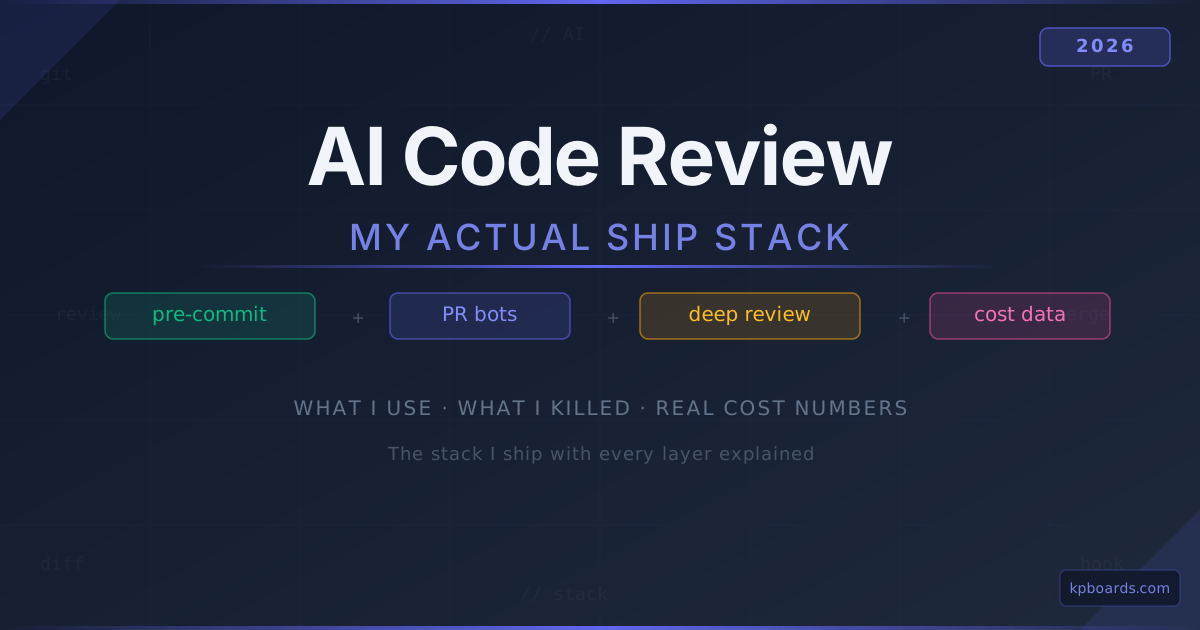
If you ship code to production every week with a team of 2 - 30 engineers and your PR queue is burying reviewers in noise, this is the stack I run. Not the aspirational one. The one my team actually uses in April 2026, with real numbers - cost per hook fire, catches per week, what I tried and killed.
TL;DR - the stack I currently ship with (April 2026)
| Layer | Tool | Cost | Why it stays |
|---|---|---|---|
| Pre-commit | Claude Code + a local hook | ~$0.03 per hook fire | Catches 80% of style / null-check nits before CI even runs |
| PR-opened check | GitHub's built-in Copilot PR | Included in Copilot Business | Summary + inline suggestions land within 90s of git push |
| Deep review | Claude Opus via Claude Code CLI | ~$0.25 - 0.60 per large PR | The only reviewer that actually reads diffs across >5 files and holds context |
| Security sweep | GitHub Advanced Security + Snyk | $21 / dev / month combined | Non-AI but pairs with Claude review - AI can't see supply-chain CVE graphs yet |
| Merge gate | Human review, 1 required | - | AI is a multiplier, not a gatekeeper |
| Cost containment | aicostcap.dev (mine) | $29/mo per team | Hard stop when monthly API spend hits cap - so a flaky loop can't drain $500 |
If you only take one thing from this article: pre-commit is where AI code review pays rent. The CI-time reviewer is table stakes. The pre-commit layer is what actually changes your team's output per day.
Why I stopped treating AI code review as "the PR bot"
For most of 2024 I ran the classic setup: Copilot in my editor, a PR bot that comments on every merge request, human review as the last gate. It felt modern. It was not helping.
The problem is where the feedback lands. A PR bot comments after you've already:
- pushed the branch
- opened the PR
- written a description
- context-switched to the next task
By the time the bot says "this function has three early returns and a missing null check," I'm reviewing someone else's code, or in a meeting, or asleep. The bot is right, but the friction cost of fixing it is 15 minutes (re-open the editor, re-read the diff, push an amend, re-run CI) instead of 15 seconds (fix it before git commit).
I switched the order. Now 80% of the AI review load happens before the commit exists. The PR-time bot becomes a second pass, not the first.
Result: our team's PR-to-merge time dropped from ~14 hours median to ~6 hours over a quarter, with no change in review quality.
The stack, layer by layer
Layer 1 - Pre-commit (where the real wins live)
Tool: Claude Code running as a git pre-commit hook.
I have a shell script at .git/hooks/pre-commit that does this:
#!/usr/bin/env bash
changed=$(git diff --cached --name-only --diff-filter=ACMR | grep -E '\.(ts|tsx|js|jsx|py|go)$')
[ -z "$changed" ] && exit 0

claude-code review \
  --files "$changed" \
  --rules ~/.config/claude/team-review-rules.md \
  --max-cost 0.10 \
  --on-issue warn
Three things make this work:
--rules team-review-rules.md- this is a 40-line markdown file with the 8 things my team actually cares about (noconsole.login prod paths, noanyin exported types, env-var reads go through a validated object, neverdangerouslySetInnerHTMLwithout sanitization, etc.). Without rules, Claude will lecture you about naming conventions nobody asked for.--max-cost 0.10- hard ceiling per hook. If a commit touches 40 files and Claude wants $0.80 to review them, it fails cleanly with a notice. Caps matter (more on this below).--on-issue warn- surfaces issues but doesn't block. A blocking AI pre-commit hook is the fastest way to get your team to disable pre-commit hooks. Warn, don't block.
Honest numbers for a mid-size Next.js repo over 30 days: 2,400 pre-commit fires, $68 in Claude API spend, ~380 real issues caught (things that would have become PR comments or CI failures). That's about $0.18 per useful catch - cheaper than 2 minutes of a senior engineer's time.
Layer 2 - PR-opened (Copilot's lane)
GitHub's native Copilot PR review is included if you're already on Copilot Business. I don't use a separate PR bot because:
- it's already there
- it fires within 60 - 90 seconds of PR open
- the summary is actually good
What it's bad at: anything that requires understanding >1 file. Copilot's PR review is a local-context reviewer. If your PR changes a hook, a screen that uses it, and a test, Copilot will review each file in isolation. That's fine for style; useless for architecture.
I keep Copilot PR review on as a fast first pass. I don't ask it questions.
Layer 3 - Deep review (the one human reviewers actually want)
This is where I run Claude Code from the CLI against the full diff, with a different prompt than the pre-commit one. Prompt boils down to:
- assume the pre-commit nits are already handled
- focus on: API shape changes, data-loss risk, edge cases the tests miss, architectural drift from the rest of the codebase
- ignore: formatting, imports, naming style
- output: a ranked list by severity, plus a one-paragraph "what this PR actually does" summary
Cost per deep review: $0.25 - $0.60 for a typical 400-line PR. I run this on any PR I'm the assigned human reviewer for, before I read the code myself. Then I read the code with Claude's summary loaded. My human review gets sharper because I spend zero time figuring out what the PR is trying to do.
This is the layer that's non-negotiable on my team. Every other layer is optional.
Layer 4 - Security (still mostly non-AI)
Claude is not a security reviewer in 2026. It misses:
- transitive dependency CVEs (no graph access)
- secrets in committed env files (low recall vs. a dedicated scanner)
- SSRF / SQLi chained through framework-specific helpers
- auth bypass via missing middleware on a new route
I run GitHub Advanced Security + Snyk. Both hit SARIF output that lands inline on the PR. AI adds nothing here; it only adds noise if you ask it to.
One exception: I do ask Claude specifically "does this PR add any new server action, API route, or middleware that should require auth?" as a narrow follow-up prompt. That catches the "someone shipped a new route without an auth guard" class of bug that scanners miss.
Layer 5 - Cost containment (why I built aicostcap.dev)
If you wire Claude into pre-commit, PR review, and deep review, you're making 500+ API calls a day across a team. One bug - an infinite loop, a leaked key, a misconfigured CI job - can burn $800 before anyone notices.
Anthropic and OpenAI only ship warnings, not hard stops. That's not acceptable for a shared engineering budget. I built aicostcap.dev to solve exactly this: hard caps per key and per project, alert at 50/80/100% thresholds, dead-key rotation at the ceiling. If you've ever gotten a $1,200 "surprise" AI bill, you know why this matters.
What I tried and killed
These are the tools and workflows I genuinely gave a fair shot and removed:
Killed: A dedicated PR bot that posts on every merge
Ran three different ones over 6 months (open source and commercial). All produced the same failure mode: comment fatigue. The bot would comment on every PR with 8 - 15 suggestions. Most were style preferences. My team started resolving comments without reading them. The signal was drowned by the volume.
The fix was not a better bot. The fix was moving review upstream (pre-commit) and keeping deep review as a human-triggered action.
Killed: AI as merge gate
Tried "PR cannot merge until AI review passes" for two weeks. Killed it within a week. Reasons:
- false positives block valid work
- real emergencies need to merge past it
- creates a "get the AI to approve it" gaming dynamic where engineers rephrase code to satisfy the reviewer instead of fixing the actual thing
AI belongs as a multiplier, not a gate. One human review remains required on my team.
Killed: Using the same model for everything
Ran Claude Opus for every layer for about a month. Cost tripled, quality did not. Now:
- Pre-commit: Claude Haiku (fast, cheap, good enough for style)
- PR-opened: Copilot's default (included)
- Deep review: Claude Opus (the one time premium is worth it)
Killed: Auto-generated PR descriptions from diff
Sounds useful, never was. Auto-generated descriptions read like a machine translated a git log: technically correct, useless for the reviewer. Worse, when developers knew the description would be auto-generated, they stopped writing good commit messages.
The working alternative: the PR description template asks two questions ("what does this change do for the user?" and "what's the riskiest thing here?") and the author fills them in.
The three questions I ask before adopting any AI review tool
- Where does the feedback land? Pre-commit > pre-push > PR-open > post-merge. Earlier is exponentially more valuable.
- Can I constrain what it reviews? If I can't hand it a rules file that says "review only these 8 things," I will get unsolicited opinions on tab width.
- What's the cost ceiling? If the tool has no per-day or per-PR cap, assume the worst bug will drain your API budget. Tools that can't cap usage don't enter production on my team.
FAQ
What model should I use for AI code review?
Claude Opus for deep review, Haiku for pre-commit pattern matching. GPT-4o Sonnet is competitive for both but costs more per token. Open-weights models (DeepSeek-V3, Llama-3.3-70B) are usable for style-only pre-commit checks but miss architectural issues; don't use them for deep review.
How do I stop AI code review from making our PRs crowded with noise?
Move 80% of the review load to pre-commit, where the author sees feedback before pushing. Keep the PR-time bot to a summary only (not inline suggestions). This is the single biggest UX improvement you can make.
Is AI code review worth it for a solo developer?
Yes, but the stack collapses: only run Claude Code as a pre-commit hook with a short rules file. Skip the PR bot (you're not dealing with comment fatigue), skip the deep review layer (you're already reading every diff). Expected cost: $10 - 30/month for a solo dev.
Does AI code review replace human review?
No. AI catches pattern issues and obvious mistakes; humans catch judgment issues ("is this the right abstraction?", "does this match our architecture?", "does the product team actually want this?"). On my team, at least one human review is required on every PR, and that's not changing.
How do I prevent runaway AI code review costs?
Three controls, in order of importance: (1) hard dollar cap per hook / per PR via the tool's CLI flags; (2) key rotation when the monthly budget hits 100%; (3) kill-switch in pre-commit (AI_REVIEW=off git commit bypass) so a flaky API doesn't block your team from shipping. I built aicostcap.dev specifically for (2) across multi-provider API keys.
Should the AI review security issues?
As a second pass, not a first. Use dedicated security scanners (GitHub Advanced Security, Snyk, Semgrep) for the heavy lifting, then ask the AI narrow security questions about specific new surfaces ("does this new route need auth?"). LLMs in 2026 still miss supply-chain CVE graphs and framework-specific auth bypasses.
Related reads
- Claude Code Review - 3 months shipping with Claude Code
- Cursor Review - the IDE-native competitor
- Windsurf Review - the third option worth evaluating
- The AI stack I ship production features with - the full playbook this article is one chapter of
- aicostcap.dev - hard spend caps for OpenAI, Anthropic, OpenRouter keys
Last verified: 2026-04-22. Next revision: 2026-07-22 (quarterly freshness pass).