Yesterday I reread an article I'd written the year before. I'd spent an entire afternoon on it, editing until late at night, and felt genuinely good about it. Reach: 312 people.
The same day, I posted a careless selfie with a three-line caption. Reach: 4,200.
I'm not blaming the algorithm. But sitting there staring at those numbers, I realized something: I was playing a game where I didn't set the rules, didn't own the field, and had no right to complain about any of it.
Convenience always has a price
I get why everyone flocks to social media. It's easy - five minutes to create an account, instant publishing, millions of people already there. If your content is "good enough" by their standards, the algorithm will push it forward.
In exchange, you hand over your behavioral data, the right to decide who sees your content, your entire content history, and ultimately, the power to define what's acceptable or not.
That last one gets overlooked most often. But it matters most.
You don't decide if your content violates community guidelines. You don't decide if your account gets locked. And if it does - through a mistake, a mass reporting campaign, an algorithm error - your appeals mostly go into a void.
The year organic reach died overnight
Around 2018 - 2019, many content creators watched their Facebook page reach collapse. Not gradually. Like falling off a cliff.
Pages with 50,000 followers getting 800 views per post without paid ads. Organic reach dropping below 2%.
People who had spent years building communities suddenly realized their "50,000 followers" was just a number in Facebook's database. Not their asset - Facebook's audience, lent to them temporarily, on terms Facebook could change at any moment.
No warning. No compensation. No negotiation. Just an algorithm update and a new reality: want reach? Pay for it.
Your own website isn't perfect. But it's yours
A personal website doesn't automatically pull in traffic. You still need SEO, distribution, and promotion through other channels.
But when someone lands on your site, they're on your land.
Your domain. Your content. You decide if posts are 200 words or 5,000. No algorithm deciding your best work gets buried. No sidebar ads for products you don't endorse. Every email address you collect belongs to your list - not Facebook's, not TikTok's. Yours.
A good article on your website can surface through Google for years. The same article on a social feed dies in 48 hours. That's not a small difference - that's the difference between building an asset and burning effort.
"But isn't it complicated and expensive?"
I hear this often. The honest answer: not anymore.
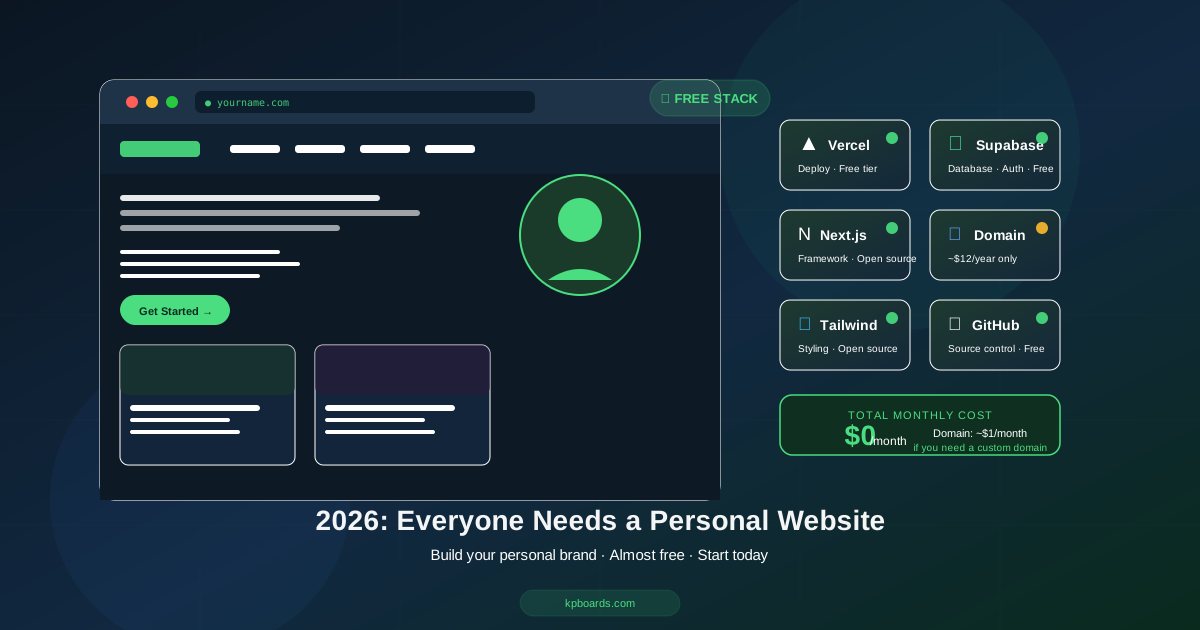
- Domain: ~$10 - 15/year - the only thing truly worth paying for
- Hosting: Vercel, Netlify, GitHub Pages - free for small projects
- CMS: Notion, Ghost, or self-built - many free options
- Newsletter: Beehiiv, Buttondown - free until your first few thousand subscribers
What we call "free" on big platforms isn't actually free. You pay with data, with dependency, with playing by someone else's rules every single day.
Compared to that, $10/year for a domain might be the best investment you make in your digital career.
Use big platforms - just don't mistake them for home
I'm not saying quit social media. I still use it daily.
But I think about it differently now. Big platforms are distribution channels - roads that help new people find me, then lead them to my website. The best, deepest, most personal content lives there, on my domain. Social platforms are just signposts.
That's the difference between using platforms as tools and living in them as a tenant.
You don't need permission to exist on your own piece of the internet
This is what I love most about having a personal website.
No algorithm to please. No guidelines to worry about. No format to optimize for the platform. No waiting for approval to publish.
You write. You publish. It's there. Simple as that.
And that domain - that small address on the internet - is yours for as long as you want it, exactly how you want it. No one can take it away.
If you've been thinking "that makes sense, but I'll do it later" - I understand. I said the same thing for years. But later rarely comes.
Buy the domain first. The name you want. Then build from there.
The land is yours. What you build on it - entirely up to you.